

Industrial Construction in Jacksonville, FL
Professional Industrial Construction in Jacksonville, FL — Licensed, Insured & Locally Owned
ShayCore, LLC delivers expert industrial construction in Jacksonville, FL. Warehouses, manufacturing plants & more. Call (904) 551-2592 for a free consultation.
- Licensed & Insured
- Locally Owned & Operated
- Free Inspection & Estimate
Request Your
Free EstimateIndustrial construction encompasses the design, engineering, and building of large-scale facilities including warehouses, manufacturing plants, distribution centers, processing facilities, and heavy industrial complexes. Unlike residential or commercial construction, industrial projects demand specialized structural systems, heavy load-bearing capacity, advanced mechanical and electrical infrastructure, and strict compliance with OSHA, EPA, and local Jacksonville zoning regulations.
Jacksonville, FL presents a uniquely dynamic environment for industrial development. As one of the largest cities by land area in the continental United States — spanning over 747 square miles — Jacksonville offers vast tracts of industrially zoned land, proximity to the Port of Jacksonville (JAXPORT), and direct access to I-10, I-95, and US-1 corridors. These geographic advantages make the region one of the Southeast’s fastest-growing industrial markets.
ShayCore, LLC delivers expert industrial construction services across Jacksonville and the surrounding region. Our team understands the local permitting process, soil conditions, hurricane code requirements, and the logistical demands of building in Northeast Florida’s competitive industrial corridor. Call us today at (904) 551-2592 to discuss your project.
Understanding Industrial Construction in Jacksonville
Industrial construction refers to a specialized branch of the construction industry focused on building structures designed to support manufacturing, logistics, energy production, processing, and heavy commercial operations. These structures differ fundamentally from standard commercial buildings in their scale, structural requirements, mechanical complexity, and regulatory oversight.
Historically, Jacksonville’s industrial development gained serious momentum in the early 20th century with the expansion of the railroad hub and the growth of naval operations at Naval Air Station Jacksonville. By the mid-1900s, the St. Johns River waterfront had become a critical artery for industrial shipping and warehousing. The expansion of JAXPORT — now one of the top vehicle-import ports in the United States — further accelerated demand for industrial facilities throughout Duval County and into Clay, St. Johns, and Nassau counties.
Today, industrial construction in Jacksonville encompasses a broad range of facility types, including:
- Tilt-up concrete warehouses and distribution centers — commonly 200,000 to 1,000,000+ square feet, serving e-commerce and logistics operators
- Manufacturing plants — including automotive parts, aerospace components, and food processing facilities
- Cold storage and refrigerated distribution facilities — critical for Jacksonville’s food and pharmaceutical supply chains
- Flex industrial buildings — multi-tenant structures combining office and light manufacturing space, popular in the Westside Industrial Corridor
- Heavy industrial facilities — including bulk liquid storage terminals and chemical processing plants along the St. Johns River
- Data centers and energy infrastructure — an emerging sector driven by Jacksonville’s fiber connectivity and stable power grid
Industrial construction projects in Jacksonville typically involve civil engineering for site grading and stormwater management, structural steel or tilt-up concrete systems, specialized MEP (mechanical, electrical, plumbing) coordination, fire suppression systems, dock levelers and truck court design, and compliance with Duval County’s Technical Construction Requirements. Understanding these integrated systems is what separates a successful industrial build from a costly, delayed project.
The Jacksonville industrial real estate market has seen vacancy rates fall below 3% in recent years, reflecting unprecedented demand and creating urgency for new construction to accommodate growing regional and national supply chain operators.
Why Industrial Construction Is in High Demand in Jacksonville, FL
JAXPORT Expansion and the Trade Corridor Effect
JAXPORT’s deepening of the St. Johns River shipping channel to 47 feet — completed under a federally funded project — has enabled larger Neo-Panamax vessels to dock in Jacksonville, dramatically increasing cargo volume. This has triggered a ripple effect of industrial facility demand within a 30-mile radius of the port, particularly along the Blount Island Terminal area and in the Northwest Jacksonville industrial zone. Warehousing and transloading facilities near Heckscher Drive and along Duval County’s North Shore have been among the most active construction zones in the region since 2019.
I-95 and I-10 Interchange — The Southeast Logistics Crossroads
Jacksonville sits at the intersection of I-95 and I-10, making it the only city in the Southeast where a north-south and east-west interstate meet at a major port city. This geographic advantage has attracted national distribution operators — including Amazon, Chewy, Wayfair, and numerous third-party logistics (3PL) companies — to develop facilities in the Westside Industrial Corridor, near Imeson Park, and along US-1 in the Baldwin area. Each new major tenant triggers additional demand for supplier, cold storage, and ancillary industrial construction.
Northeast Florida’s Climate and Soil Challenges
Industrial construction in Jacksonville must account for the region’s specific environmental conditions. The area’s sandy, low-bearing-capacity soils — particularly prevalent in the Northside near the St. Johns River floodplain and in areas such as Oceanway and Dinsmore — often require ground improvement techniques such as dynamic compaction, aggregate piers (Geopiers), or deep pile foundations to achieve the 2,000–6,000 psf bearing capacity required for heavy industrial floor slabs and racking systems.
Jacksonville’s humid subtropical climate (Köppen classification Cfa) means average annual rainfall of approximately 52 inches, with intense storm events common from June through September. Industrial sites must incorporate robust stormwater management systems compliant with the St. Johns River Water Management District (SJRWMD) permitting standards — often requiring retention ponds, exfiltration trenches, or constructed wetland buffers.
Furthermore, as a coastal city vulnerable to Atlantic hurricane activity, all industrial structures must comply with Florida Building Code (FBC) 2023 wind load requirements. For Jacksonville’s Risk Category III and IV industrial structures, design wind speeds typically range from 130 to 140 mph (3-second gust), necessitating reinforced tilt-up panels, engineered steel moment frames, and impact-rated openings.
Neighborhood-Level Industrial Growth Pressures
Established industrial neighborhoods such as Arlington’s commercial fringe, the Northwest Jacksonville Industrial District near Ribault River, and the Cecil Commerce Center — a 17,000-acre mixed-use development built on the former Cecil Field Naval Air Station — are all experiencing construction pressure as legacy buildings age beyond functional use. Many structures in these areas date to the 1960s–1980s and lack modern clear heights (today’s standard is 32–40 feet), inadequate dock ratios, and outdated electrical service for automated systems.
Population and E-Commerce Growth
Jacksonville’s population surpassed 1 million residents in Duval County’s metro area, and the Jacksonville MSA continues to rank among the fastest-growing large metros in the United States. This population growth directly fuels demand for last-mile distribution, food processing, and light manufacturing — all requiring new or expanded industrial construction.
Signs You Need Industrial Construction Services in Jacksonville
Operational Capacity Issues
- Your existing facility consistently operates above 85% storage or production capacity
- Clear heights under 28 feet are limiting your racking configurations or automated equipment
- Dock-door ratios fall below one door per 10,000 square feet, creating loading bottlenecks
- Floor flatness (F-numbers) no longer meets VNA (Very Narrow Aisle) forklift requirements
Structural and Code Compliance Concerns
- Roof systems more than 20 years old showing ponding, membrane failure, or visible deflection
- Existing facility does not meet FBC 2023 wind load standards — particularly critical after post-Hurricane Ian regulatory updates
- Column spacing under 40 feet limiting modern material handling equipment layouts
- Electrical panels insufficient for 480V three-phase service required by modern machinery
Site and Location Triggers
- Your current location lacks truck court depths of 130–185 feet required for modern 53-foot trailer operations
- Flooding risk at your current site following FEMA Flood Map revisions affecting Northeast Florida
- Zoning changes near established industrial areas like Eastside Jacksonville or Paxon neighborhood making expansion impractical
Business Growth Signals
- Lease renewals on existing space becoming cost-prohibitive given Jacksonville’s sub-3% industrial vacancy rate
- New contract awards requiring dedicated production or distribution space within 6–18 months
Our Industrial Construction Process in Jacksonville, FL
ShayCore, LLC follows a structured, transparent construction process tailored to the specific demands of industrial projects in Jacksonville and Northeast Florida. Here is how we move from concept to completion:
Site Evaluation and Feasibility (Weeks 1–3)
We begin with a comprehensive site analysis including geotechnical boring reports to assess soil bearing capacity — a critical factor given Jacksonville’s variable sandy and clay soil profiles. We review FEMA flood zone designations, SJRWMD jurisdictional wetland delineations, and Duval County zoning classifications (IL, IM, IH) to confirm site suitability. Utility availability from JEA (Jacksonville Electric Authority) for high-capacity electrical service is also confirmed at this stage.
Programming and Design Coordination (Weeks 3–8)
Working with the client’s operational team, we develop a facility program defining clear heights, column grid, dock configurations, office square footage, and fire protection classification. We coordinate with licensed Florida architects and structural engineers to develop construction documents compliant with the Florida Building Code 2023 and Jacksonville’s local amendments.
Permitting and Agency Approvals (Weeks 6–16)
Industrial permitting in Jacksonville involves Duval County’s Building Inspection Division, SJRWMD Environmental Resource Permit (ERP) for stormwater, FDOT driveway connection permits for state road access, and potentially FDEP coordination for environmental compliance. We manage this multi-agency process actively, tracking submission queues and responding to Requests for Additional Information (RAIs) to minimize delays.
Site Work and Civil Construction (Weeks 14–22)
Earthwork, underground utilities, stormwater pond construction, and pavement subbase preparation begin concurrent with structural permit approval. Florida’s wet season (June–September) is planned around to avoid delays in grading and concrete placement.
Structural System Erection (Weeks 20–36)
Depending on the structural system selected — tilt-up concrete, pre-engineered metal building, or structural steel — this phase includes foundation construction, panel tilt or steel erection, and roof system installation. We schedule concrete pours during cooler morning hours to manage Jacksonville’s summer heat and humidity effects on cure rates.
MEP, Interiors, and Systems (Weeks 32–50)
Mechanical, electrical, plumbing, fire suppression, dock equipment, lighting, and interior finishes are completed during this phase, with JEA utility connections coordinated for timely energization.
Commissioning and Certificate of Occupancy (Weeks 48–56)
Final inspections with Duval County, system commissioning, punchlist completion, and Certificate of Occupancy issuance mark project closeout. Typical industrial project timelines in Jacksonville range from 12 to 18 months depending on project scale and permitting complexity.
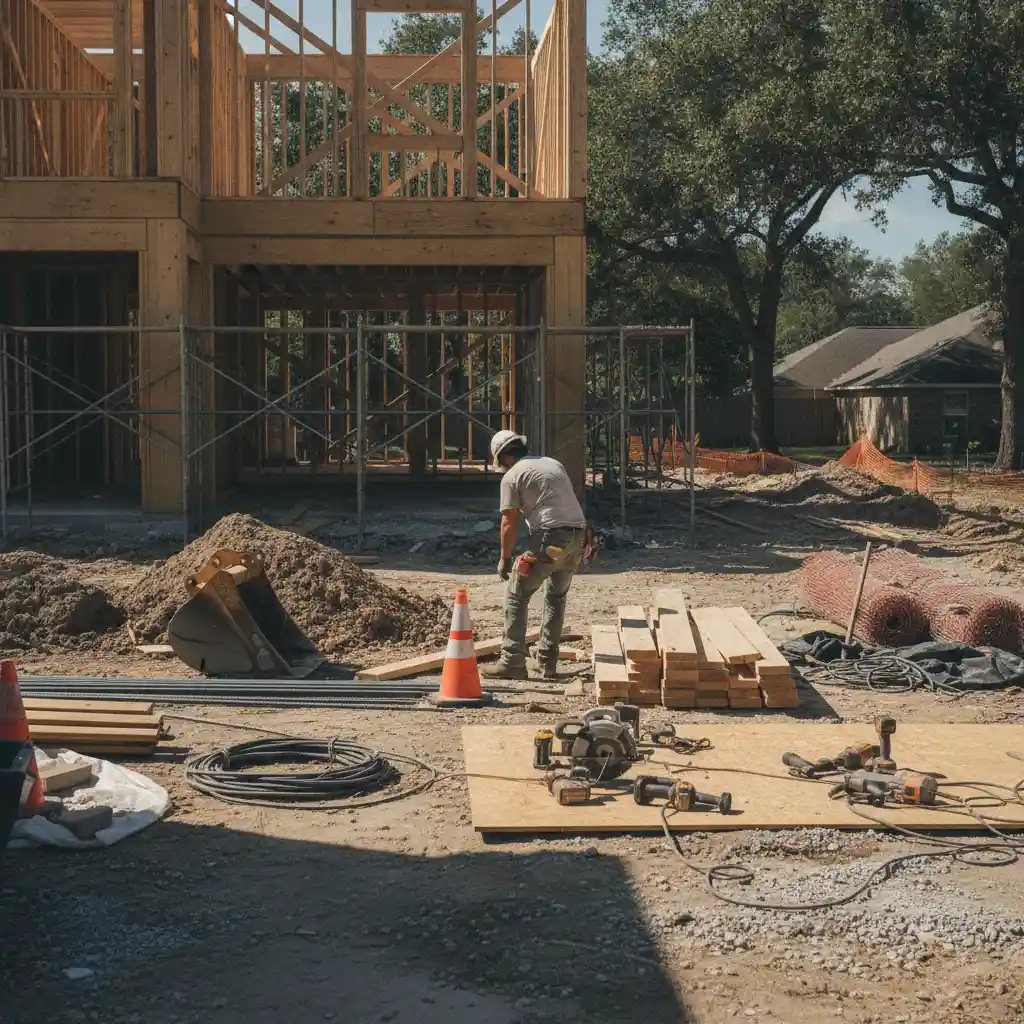
Our team in action — commercial-construction professionals serving Jacksonville
Industrial Construction Methods and Approaches We Use in Jacksonville
Tilt-Up Concrete Construction
Tilt-up construction is the dominant method for large distribution and warehouse facilities in Jacksonville’s Westside and Northside industrial corridors. Concrete panels are cast on-site and tilted into position, offering speed, durability, and excellent wind resistance — critical for meeting Jacksonville’s 130+ mph design wind requirements. This method is ideal for facilities over 50,000 square feet with clear heights of 28–40 feet.
Pre-Engineered Metal Buildings (PEMB)
For flex industrial, light manufacturing, and smaller warehouse applications (10,000–100,000 square feet), pre-engineered metal building systems offer cost efficiency and faster delivery timelines. These systems are engineered to meet Florida’s strict wind uplift and seismic requirements and are particularly common in the Cecil Commerce Center and Imeson Park developments.
Structural Steel with Concrete or Metal Deck
Heavy manufacturing facilities, cold storage buildings with specialized insulated panels, and multi-story industrial structures utilize structural steel framing systems. This approach allows maximum design flexibility for complex mechanical layouts, heavy overhead crane loads (up to 40+ ton capacity), and specialized process equipment integration.
Ground Improvement Techniques
Given Jacksonville’s challenging soil conditions — particularly in Northside neighborhoods near the St. Johns River where loose sands and high water tables are prevalent — ground improvement methods such as vibro-compaction, Geopier aggregate piers, or driven concrete pile foundations are employed to achieve required slab bearing capacity of 2,000–5,000 psf for heavy rack loading.
Design-Build Delivery
For clients needing accelerated timelines, ShayCore, LLC offers design-build project delivery, integrating design and construction under a single contract. This approach has proven especially effective for tenant-driven build-to-suit projects in Jacksonville’s active industrial market, reducing overall project delivery time by 15–25% compared to traditional design-bid-build.
Ready for Industrial Construction? Get Your Free Estimate Today.
ShayCore, LLC serves Jacksonville and the surrounding area — we’ll be on-site within 24 hours.
📞 Call (904) 551-2592Industrial Construction Cost in Jacksonville, FL
Understanding industrial construction costs in Jacksonville helps you plan accurately and evaluate proposals. Pricing varies significantly based on facility type, size, specifications, and site conditions specific to Northeast Florida.
General Cost Ranges
- Basic tilt-up warehouse/distribution center (shell): $65–$95 per square foot
- Turnkey distribution center with dock equipment, lighting, and basic office: $95–$140 per square foot
- Pre-engineered metal building (flex industrial): $45–$80 per square foot
- Cold storage/refrigerated facility: $150–$250 per square foot due to insulated panels, refrigeration systems, and vapor barriers
- Heavy manufacturing facility with crane bays: $120–$200+ per square foot
- Data center or mission-critical industrial facility: $300–$600+ per square foot
Key Cost Factors in Jacksonville
- Site conditions: Poor soil bearing capacity requiring ground improvement adds $5–$25 per square foot, a common issue in Northside Jacksonville near the St. Johns River floodplain
- Stormwater management: SJRWMD permitting and retention pond construction adds $200,000–$800,000+ depending on site acreage and impervious coverage
- Hurricane wind design: Engineering for 130–140 mph wind zones adds 3–8% to structural costs compared to inland markets
- JEA utility connection: High-capacity electrical service connections in outer growth areas (Baldwin, Macclenny corridor) can add $100,000–$500,000 depending on proximity to distribution infrastructure
- Permitting fees: Duval County charges approximately $8–$12 per $1,000 of construction value for building permits
Contact ShayCore, LLC at (904) 551-2592 for a project-specific estimate. We provide detailed cost breakdowns and value engineering options to maximize your construction budget in Jacksonville’s competitive market.
Jacksonville Neighborhoods and Areas We Serve
Northwest Jacksonville / Imeson Park
This established industrial corridor hosts facilities dating to the 1970s–1990s alongside newly developed Class A distribution centers. Aging infrastructure and undersized buildings (under 24-foot clear heights) drive significant replacement construction demand. Proximity to I-95 and Heckscher Drive makes this zone ideal for port-adjacent logistics.
Cecil Commerce Center (Westside)
Built on the 17,000-acre former Cecil Field Naval Air Station, this master-planned industrial park is one of the Southeast’s premier development sites. Facilities here range from 50,000 to 1,000,000+ square feet. Soil conditions are generally favorable for construction, though stormwater management for large impervious areas remains a key design consideration.
Northside / Oceanway / Dinsmore
Rapid industrial growth along the Duval-Nassau County line, driven by port expansion and I-95 access. High water tables and loose sandy soils require careful geotechnical planning. New developments in this corridor often require deep foundation systems.
Baldwin and West Duval County
Emerging industrial zone along US-90 and the CSX rail corridor. Large tracts of affordable industrially zoned land attract manufacturing and heavy industrial users seeking rail-served sites.
Blount Island / JAXPORT Area
Highly specialized zone for port-related industrial construction including transloading, container storage, and vehicle processing facilities. Unique permitting requirements and environmental oversight apply in this area.
Industrial Facility Maintenance Tips for Jacksonville Property Owners
Protecting your industrial construction investment in Jacksonville requires proactive maintenance adapted to Northeast Florida’s climate and environmental conditions.
- Annual roof inspections before hurricane season (May 1): Inspect membrane seams, penetrations, and drainage scuppers. Jacksonville’s 52-inch annual rainfall and storm surge risk make roof integrity non-negotiable.
- Stormwater system quarterly inspections: Clear retention pond inlet structures, exfiltration trenches, and swales of sediment and vegetation. SJRWMD permit compliance requires documented maintenance records.
- Concrete floor joint inspection and resealing: Jacksonville’s temperature swings (30°F winter lows to 95°F+ summer highs) cause significant concrete slab movement. Resealing control joints annually prevents water infiltration and forklift damage.
- Exterior tilt-up panel caulk inspection: UV degradation from Florida’s intense sun exposure breaks down panel joint sealants within 5–7 years. Reapply every 7–10 years.
- Dock leveler and seal lubrication (semi-annually): Salt air from Jacksonville’s coastal proximity accelerates corrosion in dock hardware. Apply marine-grade lubricants seasonally.
- HVAC and ventilation system servicing (quarterly): Industrial facilities in Jacksonville’s high-humidity environment are susceptible to mold growth in HVAC systems. Change filters and inspect drain pans regularly.
- Parking lot and truck court pavement inspection (annually): Florida’s wet-dry cycle causes asphalt fatigue. Seal cracks before summer rains to prevent base failure beneath heavy truck traffic.
- Fire suppression system annual testing: Required by Florida Fire Prevention Code and critical for maintaining insurance compliance.
Why Choose ShayCore, LLC for Industrial Construction in Jacksonville
When you choose ShayCore, LLC for your industrial construction project in Jacksonville, you gain a partner with deep roots in Northeast Florida’s construction landscape and a thorough understanding of the unique demands this market presents.
Our team brings hands-on experience navigating Jacksonville’s specific permitting environment — including Duval County Building Inspection, SJRWMD Environmental Resource Permits, FDOT driveway connections, and JEA utility coordination. We don’t learn your market on your project’s time and budget.
We maintain established relationships with Northeast Florida’s top structural engineers, geotechnical firms, and specialty subcontractors — the partnerships that keep projects on schedule even when Jacksonville’s summer storms or supply chain disruptions create pressure. Our subcontractor network includes firms with proven track records on tilt-up, structural steel, and pre-engineered metal building projects across Duval, Clay, St. Johns, and Nassau counties.
ShayCore, LLC prioritizes transparent communication, detailed scheduling, and honest cost management. We understand that your industrial facility is a critical business asset, and we treat your project with that level of accountability from the first site visit through Certificate of Occupancy and beyond.
Ready to discuss your Jacksonville industrial construction project? Call us at (904) 551-2592 today.
Learn more about ShayCore, LLC
Frequently Asked Questions About Industrial Construction in Jacksonville, FL
How much does industrial construction cost in Jacksonville, FL?
Industrial construction costs in Jacksonville typically range from $65 to $95 per square foot for basic tilt-up warehouse shells, $95 to $140 per square foot for turnkey distribution facilities, and $150 to $250+ per square foot for cold storage or specialized manufacturing. Jacksonville-specific cost factors include soil improvement for Northside and riverside sites, stormwater management compliance with SJRWMD standards, and Florida Building Code hurricane wind design requirements. Contact ShayCore, LLC at (904) 551-2592 for a detailed project estimate.
How long does an industrial construction project take in Jacksonville?
Typical industrial construction timelines in Jacksonville range from 12 to 18 months for new ground-up facilities. This includes 2–4 months for design and permitting through Duval County and SJRWMD, 1–3 months for site work, and 6–10 months for structural and interior construction. Projects in flood-prone areas requiring additional FEMA and SJRWMD permitting may add 2–4 months to the schedule.
What permits are required for industrial construction in Jacksonville?
Industrial construction in Jacksonville typically requires a Duval County Building Permit, an SJRWMD Environmental Resource Permit (ERP) for stormwater management, FDOT driveway connection permits for state road access, a JEA utility connection agreement, and potentially FDEP permits for projects involving environmental impacts. Fire suppression and hazmat storage involve additional Florida Fire Prevention Code review.
What soil conditions should I expect on Jacksonville industrial sites?
Jacksonville’s soils vary significantly by location. Sites in the Northside near the St. Johns River floodplain and in areas like Oceanway and Dinsmore commonly feature loose sands and high water tables, often requiring ground improvement or deep pile foundations to achieve required bearing capacities. Cecil Commerce Center and Westside sites generally offer more favorable soil conditions. A geotechnical investigation with soil borings is essential before finalizing any industrial site acquisition in Jacksonville.
Does Jacksonville’s hurricane zone affect industrial building design?
Yes, significantly. Jacksonville is located in a Florida Building Code wind speed zone requiring industrial structures to be designed for 130–140 mph (3-second gust) wind loads depending on Risk Category. This affects structural panel thickness in tilt-up buildings, steel connection design, roof uplift engineering, and door and opening specifications. FBC compliance is non-negotiable and adds approximately 3–8% to structural costs compared to lower wind-zone markets.
What is the best area in Jacksonville for a new industrial facility?
The best location depends on your operational priorities. For port proximity and container logistics, the Northside/Blount Island corridor is optimal. For interstate access and large development parcels, Cecil Commerce Center (Westside) and the Imeson Park area offer excellent options. For rail-served manufacturing or heavy industrial uses, the Baldwin/West Duval corridor along the CSX rail line is worth consideration. ShayCore, LLC can help evaluate site-specific factors for your operation.
Can ShayCore, LLC handle design-build industrial projects in Jacksonville?
Yes. ShayCore, LLC offers design-build project delivery for industrial clients seeking faster timelines and integrated cost control. Design-build has become increasingly popular for Jacksonville build-to-suit projects given the competitive industrial leasing market and tenant demand for accelerated occupancy. This delivery method can reduce total project timeline by 15–25% compared to traditional design-bid-build approaches.
What types of industrial facilities does ShayCore, LLC construct in Jacksonville?
ShayCore, LLC constructs a wide range of industrial facility types in Jacksonville including distribution centers, warehouses, light and heavy manufacturing plants, cold storage facilities, flex industrial buildings, and logistics support facilities. We serve clients in sectors including e-commerce, food and beverage, aerospace, automotive parts manufacturing, and third-party logistics (3PL). View all our construction services
Start Your Jacksonville Industrial Construction Project Today
Whether you are planning a new ground-up distribution center, expanding an existing manufacturing facility, or replacing an aging industrial building in Jacksonville, ShayCore, LLC is ready to deliver. We bring local expertise, proven processes, and a commitment to on-time, on-budget project execution to every industrial construction engagement in Northeast Florida.
Jacksonville’s industrial market is moving fast — available land is shrinking, vacancy rates are at historic lows, and demand from national operators continues to accelerate. The time to plan and build is now.
Contact ShayCore, LLC today:
- Call or text: (904) 551-2592
- Request a free project consultation
Our team is standing by to evaluate your site, discuss your operational requirements, and develop a construction strategy built for Jacksonville’s unique industrial landscape. Let’s build something exceptional together.